
Newsletter Subscribe
Enter your email address below and subscribe to our newsletter
Enter your email address below and subscribe to our newsletter

 ByJohn A
The landscape of executive education in the United States has undergone a fundamental transformation. Mid-career professionals and senior executives are returning to elite business schools and graduate frameworks at unprecedented rates. Driven by shifts in generative AI, corporate restructuring, and the demands of modern global supply chains, an advanced credential from a top-tier US institution has never been more valuable. However, the admissions gateway for an Executive MBA (EMBA) or a specialized executive Master of Science differs drastically from traditional graduate tracks. Admissions committees are not looking for raw academic potential; they are auditing verified strategic impact, leadership maturity, and an applicant’s prospective contribution to the cohort’s peer-to-peer learning environment.
For mid-career candidates, the single most significant friction point in this process is translating decades of dense operational experience into a coherent, forward-looking personal narrative. Academic committees are routinely overwhelmed with transcripts, recommendation letters, and corporate resumes that look structurally identical. Consequently, the Statement of Purpose (SOP) has evolved into the definitive metric for evaluation. It acts as an executive summary of your professional past, a philosophical defense of your leadership ethos, and a rigorous strategic roadmap for your professional future. Striking this balance requires a highly sophisticated approach to executive positioning, where self-branding must be balanced with objective academic alignment.
Navigating this complex editorial balance is precisely why many senior leaders run into writing blocks. Distilling 15 to 20 years of technical proficiency, organizational turnarounds, and cross-functional leadership into a precise 1,000-word essay demands an outside, professional perspective. To bridge this critical gap, a growing number of corporate leaders routinely leverage specialized SOP Writing Services to ensure their career narratives are structured with the executive poise, thematic clarity, and institutional alignment that top-tier US admissions committees expect. These professional frameworks help transform plain operational resumes into highly compelling, conversion-focused personal statements.
To author a compelling SOP, you must first understand the operational realities of the admissions panel. Unlike standard graduate programs where a high GMAT/GRE score or an exemplary undergraduate GPA can compensate for a lack of experience, executive tracks weigh professional maturity above all else. According to recent data from the Executive MBA Council (EMBAC), the average executive student in the United States enters a program with 14.6 years of work experience, including 9.2 years of direct managerial responsibility. Admissions offices are fully aware that their program’s marketplace value relies heavily on the quality of the classroom dialogue. Therefore, your SOP must explicitly prove that you can act as a contributor to this collective intellectual capital, not just a passive consumer of information.
Furthermore, the financial and temporal commitment of US executive programs introduces an institutional risk factor. With elite programs at universities like Wharton, Columbia, and Chicago Booth exceeding $200,000 in tuition, admissions panels want clear proof that candidates possess both the corporate backing and the cognitive resilience to manage rigorous academic deliverables alongside demanding executive roles. If your writing appears overly fragmented or lacks a unified strategic vector, the committee will question your capacity to execute. For international executives juggling regional migration or multinational balancing acts alongside these coursework parameters, the operational stress can compromise written output. In such complex instances, professional support systems can offer relief; for example, many global candidates opt to delegate concurrent technical writing or auxiliary coursework by telling trusted agencies to do my assignment for me to preserve their cognitive bandwidth for high-stakes application essays.
A standard graduate essay flows chronologically from college to career. An executive SOP rejects this framework completely. It must open immediately with your current strategic scope and future vision, utilizing your historical milestones solely as historical evidence to back your future goals. We can organize this architecture into three primary structural pillars, which are visualized below in our logic-to-landscape breakdown.
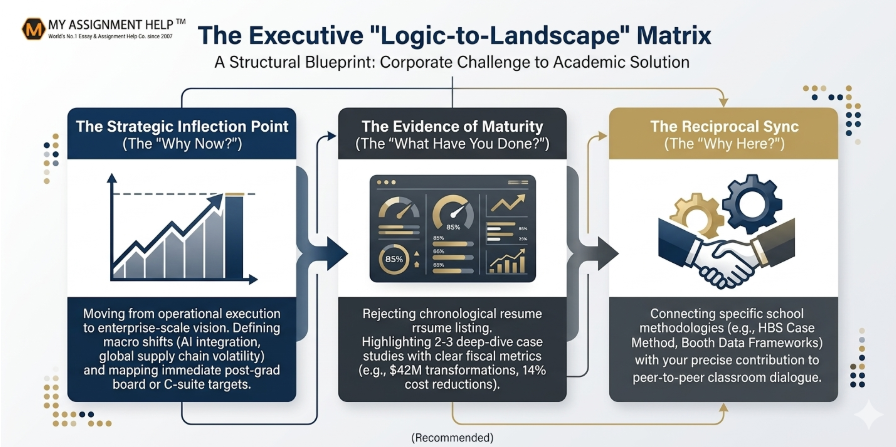
Do not begin your SOP with standard clichés like “I have always been fascinated by organizational dynamics.” Instead, frame your opening around a live corporate challenge or market shift. For instance, an executive in the energy sector might begin by addressing the tactical complexities of balancing immediate fiscal returns with mid-century decarbonization goals. This immediately positions you as a forward-thinking, macroscopic leader. Within the first two paragraphs, you must explicitly state your target short-term and long-term career goals post-graduation. US institutions value absolute clarity; they want to know exactly what board seats, C-suite roles, or entrepreneurial ventures you are targeting.
Once you establish your future trajectory, you must validate it by anchoring it to your past achievements. This is where many applicants make the mistake of rewriting their resume in paragraph format. Your SOP should instead act as an analytical commentary on your resume. Select two or three definitive career highlights that prove high-level leadership. Avoid vague descriptors like “managed a large team” or “oversaw project deployment.” Instead, use highly specific corporate language: “Directed a $42M cross-functional digital transformation framework that consolidated regional supply chains across North America, resulting in an 14% operational cost reduction within 18 months.” This data-driven framing satisfies the strict E-E-A-T criteria utilized by competitive admissions processes.
The final section of your SOP must answer a critical question: Why this specific school, and why now? Generalized statements about a university’s prestige indicate a generic, boilerplate application. You need to reference specific elements unique to that institution. Discuss distinct electives, specialized research centers, or the specific pedagogical methodology employed by the faculty (such as Harvard’s Case Method or Chicago Booth’s data-driven frameworks). More importantly, define your contribution. Will your experience managing cross-border M&A transactions in emerging markets help ground classroom discussions on global finance? Explicitly outlining this reciprocal value proposition is essential to converting an application from a “maybe” to an definitive “admit.”
To highlight the highly competitive landscape facing applicants to top-tier US executive programs, consider the operational metrics across various tiers of institutions. The following structured analysis outlines acceptance dynamics, showing how critical a well-differentiated SOP is to overcoming low structural acceptance rates:
| US Program Tier | Avg. Work Experience | Primary SOP Screening Focus | Estimated Acceptance Rate |
| Tier 1: Elite Ivy League / M7 (e.g., Wharton, Columbia, Booth) | 12 – 17 Years | Global strategic impact, C-suite potential, enterprise scaling execution | 12% – 18% |
| Tier 2: Top-25 National Brands (e.g., NYU Stern, Michigan Ross) | 10 – 14 Years | Cross-functional leadership acceleration, local market influence | 22% – 30% |
| Tier 3: Regional Powerhouses (e.g., State University Executive Tracks) | 8 – 12 Years | Operational management proficiency, immediate regional career mobility | 40% – 55% |
Writing an executive-level statement of purpose requires steering clear of standard academic prose. Admissions officers tracking elite cohorts frequently complain about the “Resume Trap”—when a candidate spends valuable space re-listing roles and dates easily found on their LinkedIn profile or resume. Your SOP shouldn’t focus on what you did, but rather on how you thought while doing it. It should showcase your strategic decision-making, your philosophical approach to navigating organizational ambiguity, and how you learned from high-stakes professional failures.
Another major pitfall is an overly humble tone that obscures your actual achievements. While humility is highly valued in collaborative environments, an executive application requires absolute clarity regarding your specific institutional impact. If a joint venture succeeded under your direction, clearly differentiate your individual strategic actions from the general team effort. Conversely, avoid sounding arrogant; frame your successes as collaborative milestones achieved through strategic alignment, cultural leadership, and clear operational vision.
See also: How Technology Improves Supply Chain Efficiency
Most top-tier US executive programs require an SOP between 500 and 1,000 words. Unless specified otherwise, aim for a clean, tightly structured 800-word essay. Admissions committees prioritize concise, executive-level writing that delivers maximum impact per page.
Only if it falls significantly below institutional baselines. If you completed your undergraduate degree over a decade ago, your recent professional trajectory, executive assignments, and P&L responsibilities carry far more weight than old academic scores. Keep any necessary explanations brief, objective, and focused on your professional growth.
It is best to minimize them. While your application will be reviewed by business school professionals, an essay weighed down by highly specific internal acronyms loses its narrative flow. Use clear, accessible corporate terminology focused on strategy, revenue, leadership, and operational scale.
Yes, structurally. A Statement of Purpose is highly professional and forward-looking, focusing heavily on your strategic career goals, business milestones, and corporate trajectory. A Personal Statement allows for more autobiographical background, focusing on the personal experiences and values that shaped your leadership style.
Dr. Marcus Vance is an education consultant and lead academic content architect at myassignmenthelp.com. With over 14 years of experience analyzing graduate admissions trends in the United States, Dr. Vance holds an M.Ed. from Boston University and a Ph.D. in Higher Education Administration from the University of Texas at Austin. He specializes in helping mid-career and senior executive applicants translate complex corporate achievements into compelling personal statements for M7 business schools and elite executive programs worldwide.
